Literati — Progress
by Bailey Massey
William Parker Wrothgate’s The Future Paradox—or “TFP,” as it is affectionately called in scientific and literary circles—immediately revolutionized science fiction when it was published 36 years ago. Called “brilliant,” “genius,” and “utter genius” by critics, the novel won Wrothgate both a Pulitzer Prize for Fiction and a Nobel Prize in Physics for his “innovative ideas regarding jet propulsion.” Wrothgate became an instant celebrity, mobbed everywhere by fans, scientists, and paparazzi. In his celebrated commencement address to the Harvard Class of 1974, Wrothgate promised to continue his life goal of “imagining a technology that is at once unfathomable and unquestionable” with his next work.
Although he is still considered to be a key member of the literary intelligentsia, since 1974, Wrothgate has not published a single word. This week, he breaks that silence with The Astronaut’s Lament.
“It’s not that I haven’t been writing,” said Wrothgate in his first interview in 30 years, recently aired on Dateline, “I’ve constantly been working from my cabin in the Berkshires. It’s just that every time I sent a draft to my publisher, there have been issues.”
The “issues” to which Wrothgate alludes are with the futuristic worlds he imagines. In the earliest incarnation of The Astronaut’s Lament, then called Artificial Feeling, the main character, Alexander Gerbain, is injured in an interstellar laser battle in the first few pages, and his crew must devise an artificial heart for him. Wrothgate’s understanding of artificial transplant technology was detailed and expert—he spent at least 200 of the draft’s 280 pages detailing the device and the specifics of the operation. Wrothgate’s ideas were accurate—so accurate, in fact, that they could be mistaken for transcripts of the first real artificial heart transplant in 1978, which occurred two days after Wrothgate finished the draft.
Insisting he could come up with something completely new, Wrothgate returned to writing with a vengeance. In the second incarnation of the book, Galactic Connection, Gerbain has no heart issues. Instead, he tries to connect with survivors of an interstellar laser battle by constructing a massive “Intermat” sweeping the galaxy, where beings from all planets can communicate. The draft was finished August 6th, 1991, the same day CERN published the World Wide Web Project. Witnesses say that when Wrothgate saw headlines about the project, he started tearing at his clothes and muttering about anti-matter.
It is rumored that Wrothgate went through 26 drafts of The Astronaut’s Lament. Titles such as Red Planet Rover, Dilly the Clone, and iPod all had to be scrapped, as their plots hinged upon imagined technologies that quickly came to mirror inventions like the Hubble Telescope, the development of the Human Growth Hormone, and, most recently, the video streaming and social networking service Wizi.
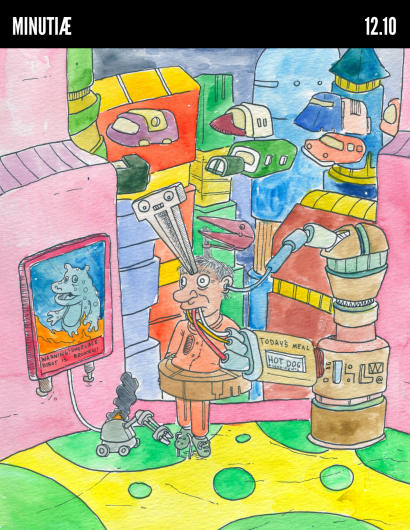
Wrothgate’s final product, then, is a departure from what the author originally pictured. As it stands, The Astronaut’s Lament story gives the last thoughts of a dying Lt. Gerbain after the galaxy has been decimated in a series of interstellar laser battles. The 2,200-page tome is written in a stream-of-consciousness style as Gerbain, on a foreign planet, with his back broken, lies waiting for his oxygen tank to run out. It has no punctuation and includes several expanses of blank pages interspersed throughout, as well as various abstract drawings by the author. There are no unfathomable yet unquestionable inventions presented, just simple descriptions of foreign bodies seen through the shattered window of a spacecraft and the childhood memories those images evoke for Gerbain. When asked what he wanted to say with the work, Wrothgate sighed, “Future… in… space?”
The Astronaut’s Lament is published by Bryce Turner House and is available now in hardcover. It will be released soon for the Kindle, a device Wrothgate envisioned last June. ♦